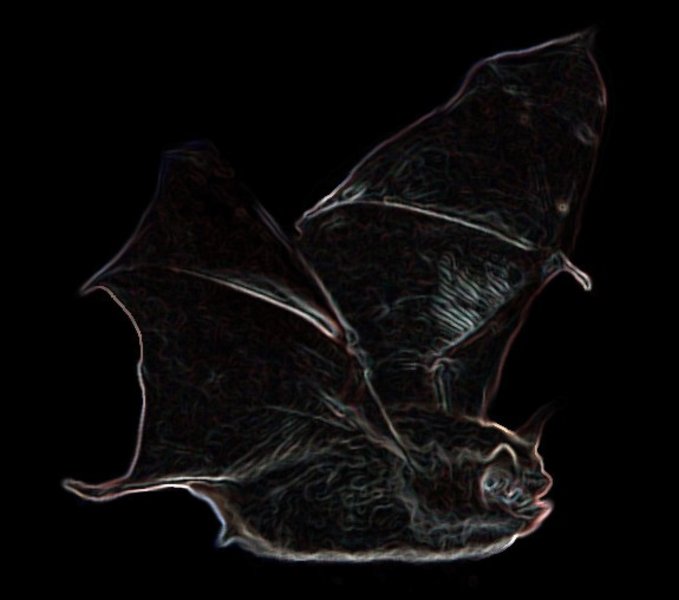
Bats are a very species-rich group of mammals. Worldwide, there are over 1,500 different bat species. Bats are the only group of mammals capable of actively sustained flight. Combined with their ability to echolocate – using the echoes returning from their own ultrasonic sound signals to navigate and find food at night - they can exploit a niche in nature that other mammals and birds cannot. At least 17 bat species occur in Denmark. All of them primarily eat insects but have different hunting behaviours, lifestyles, and habitat requirements.
In the bat group, we work to understand how the different bat species use the landscape, to develop and use methods to monitor the status of our bat species and identify the threats they face. Our research and research-based consultancy work helps the authorities improve protection and knowledge-based management of bats and their habitats.
We primarily use acoustic recordings of echolocation calls to identify bat species. In addition, we work on automating the identification and classification of bat calls, tagging bats to track their movements, as well as camera monitoring and image recognition of species.
In addition, we also work with other mammals, including birch mice and mustelids.
All bat species in Denmark are strictly protected by the EU Habitats Directive. This obligates member states to ensure a favorable conservation status for the species. Bats are extensively monitored at selected sites across the country to track changes in species distribution. The species are recorded acoustically, supplemented by direct observations and captures at selected locations.
The monitoring program is not designed to estimate species population sizes or distribution across areas that are not included in the monitoring effort.
The Bat Group assists nature authorities in preparing Technical Guidelines (method descriptions) for national monitoring. The Bat Group has also carried out field monitoring for several years in collaboration with selected consultants.
Results of the monitoring can be seen here: https://novana.au.dk/arter
The method description can be found here: https://ecos.au.dk/forskningraadgivning/fagdatacentre/biodiversitet/tekniske-anvisninger
Wind turbines pose a risk to bats, both on land and at sea. Bats are killed when struck by turbine blades and may lose or face degraded habitat as a consequence of wind farm development. Offshore wind turbines present a risk when bats hunt or migrate over the sea. With the expansion of wind energy production, the cumulative effects of wind turbines are an increasing concern for bat populations.
The Department of Ecoscience has been part of several major projects for the Danish Energy Agency on the impact of offshore wind farm development on nature and the environment in Danish waters. In a recent project, we summarized and evaluated existing knowledge and analysed compiled survey data on bats offshore to map marine areas where wind turbines pose a relatively high, medium or low a risk to bat populations. Sensitivity is considered highest along a nationwide coastal zone of 0-20 km and across inner Danish waters.
The intensity and quality of existing studies from environmental assessments vary greatly. Therefore, it is complex and not always possible to compare data and assessments from individual wind turbine projects, and the approach of evaluating projects one by one is unsuitable for estimating population-level impacts. To obtain a more consistent and data-driven overview of bat occurrence over Danish marine areas, the Bat Group aims to continue developing our framework for a comprehensive, systematic analysis based on shared raw data from acoustic surveys based on coordinated methodology in marine and coastal areas.
Links:
The bat species present in Denmark eat mostly insects. During the winter months when insects are not active, some of our bat species migrate long-distance to more southern locations, while the rest go into hibernation, where their heart rate and body temperature drop to put them into a deep winter sleep. Underground spaces such as natural caves or mines are often ideal hibernation spots, if they offer stable temperature and humidity, combined with minimal disturbance.
When many individuals aggregate in the same underground location, we have the unique opportunity to monitor the number of species and individuals per species that roost there. This has historically been done by manual counts within the caves while bats are sleeping, or by intermittently trapping most of the individuals as they leave the cave in spring after hibernating in Winter. Although everything is done to minimise disturbance, this remains a costly and stressful operation, even more so at sites with high numbers of bats.
Since 2013 bats entering and leaving Mønsted Limestone Mines have been monitoring with a system that uses paired infrared light diodes to register the number and flight direction of passing bats as they interrupt the light beams. In 2022, we upgraded the diode system with two cameras, so we are now able to not only count the overall number of hibernating bats at the site but also identify species and monitor their populations. This is especially relevant for the pond bat, since a large part of the Danish pond bat population is estimated to hibernate in this cave system and because the conservation status of this species is vulnerable according to the Danish Red List. In a pilot study we have shown that an AI can be retrained to detect and species classify individual bats in these images. We are currently working on refining the AI and camera monitoring method to make it feasible for long-term monitoring to map activity patterns and population developments in this amazing cave system. This work is financed by a 2.5 million grant from Aage V. Jensen Nature Foundation, including funding for a two-year postdoc soon to join our group.
Risk assessments of pesticides for birds and mammals are very general and do not take into account the special lifestyle of bats. Pesticides are often applied in the evening and nighttime hours to avoid spraying pollinating insects or because weather conditions are favorable. Since bats often hunt in agricultural landscapes—over fields, along hedgerows and forest edges, and in orchards—there is a risk that they are exposed to pesticides, both directly and through poisoned insects. Furthermore, there is very little knowledge about the toxicity of pesticides to bats.
This project examines the exposure risk for bats in time and space by comparing spatial and temporal patterns of bat activity in agricultural areas and orchards with models of typical pesticide use patterns in different crop types.
The project is funded by the Danish Environmental Protection Agency’s pesticide research program and carried out in collaboration with Aarhus University’s Social-Ecological Systems Simulation centre (SESS).
Link will be active once the report is published.
The northern birch mouse is both listed in Appendix II of the Bern Convention and Annex IV of the EU Habitats and Species directive, meaning that the species needs to be monitored. However, due to its partly nocturnal lifestyle in wet meadows and forests, the monitoring is mostly performed using wildlife camera traps. These cameras are triggered by movement and thus collect large amounts of images across a broad range of animals. To find birch mice among these thousands of images is a tedious and hour-intensive task, resembling looking for a needle in a haystack.
With the current developments in artificial intelligence, convoluted neural networks (CNN) have been shown to be capable of recognizing and classifying objects in images. We are working on training such a CNN to classify images by depicted animals, to aid in the monitoring of birch mice.
Morten Elmeros conducts research and provides research-based advice to authorities on the biology, lifestyle conservation and management of terrestrial mammals with a focus on bats and mustelids (e.g. otter, martens and weasel). The projects cover topics such as population dynamics, diet, health status and genetics of native and invasive predators, exposure to environmental pollutants (e.g. rodenticides), pesticide exposure risk for bats, counts in hibernacula and radio tracking of bats, monitoring of bats and mustelids (e.g. acoustic and wildlife cameras), effects of onshore and offshore wind turbines, effectiveness of mitigation measures, road ecology and invasive species. Other projects include the national monitoring of bats and other terrestrial mammals, assessments of the red list and conservation status of mammals, and the preparation of monitoring manuals and research-based guidelines on the conservation and management of bats and other terrestrial mammals.
Signe is an experienced field biologist with over 15 years of expertise from basic and applied research in bat echolocation, bat behavioural ecology and bioacoustics. Focal topics include the use and development of passive acoustic and camera-based monitoring methods to inform bat conservation and management. Current and recent projects include bat population monitoring with Mønsted Kalkgruber, the national bat monitoring program (part of NOVANA), survey manager for offshore baseline surveys of bats, birds and marine mammals for prospected wind farms in the North Sea I area.

Simeon is working on quantifying the distribution, activity patterns and abundance of Danish bat species. His current focus is on developing tools to use passive acoustic monitoring and camera trap images in hibernation sites to quantify activity patterns and abundance estimates for multiple bat species. This includes developing data pipelines, training deep neural networks, and adapting statistical models to deal with uncertainties in the data collection as well as all covariates affecting activity and abundance. Current projects include the quantification of bat activity above the North Sea I area using bespoke Bayesian models; developing BatSpot, a neural network for the detection and classification of bat calls; and the retraining of BatNet, a neural network for bat classification from images.

Julie Dahl Møller focuses on monitoring birch mice populations for the NOVANA program and environmental impact assessments linked to construction projects. Her work involves deploying camera traps to document species presence and habitat use with a focus on birch mice, ensuring compliance with conservation regulations. She also contributes to expert reports and guidance for biodiversity management, bridging scientific monitoring with practical implementation in infrastructure planning.

Esben’s work is focused on applied research and scientific advisory activities within mammal ecology, with particular emphasis on bats. Esben has extensive experience with fieldwork, acoustic detection, data analysis, and the development of methodologies for national monitoring. He has contributed to several research-based reports and projects under DCE – Danish Centre for Environment and Energy, including the NOVANA monitoring programme, where the results support national biodiversity management and the implementation of EU conservation policies. Esben’s work is characterised by a strong integration of scientific methodology and practical nature management, aiming to provide evidence-based support for environmental decision-making.

To investigate biological systems and animal behaviour, Klara focuses on the development and application of methodological and technological advancements and data assessments. She is driven by a passion for animal welfare and wildlife conservation. In her current position, Klara applies machine learning and deep learning approaches to analyse acoustic data, specifically echolocation calls of bats recorded using passive acoustic monitoring, and images from wildlife camera traps.
She also has a background in scientific outreach, specifically for youth and children, and enjoys making science and coding fun and accessible to everyone.
Will has a background in electronic engineering and has applied this to a wide range of research projects. This includes evolution of cricket mating systems, sleep and neurodegenerative disease with sheep, the impacts of offshore wind on seabird movements, and the ability of bats to navigate using the earth’s magnetic field. He is currently working on an automated bat-monitoring project, using triggered infrared cameras and AI pipelines to detect bat species entering a Danish hibernaculum.
In her Master’s thesis, Marcela will investigate how environmental factors shape night-to-night variation in bat activity at Mønsted Kalkgruber, and whether these relationships differ among species and change across the winter season. The study will provide insight into their winter behavior and offer a basis for understanding how future changes in climate and weather patterns may influence bat activity at hibernacula.
In her internship, Laura studies whether passive acoustic monitoring can distinguish migratory movements from foraging activity in the Nathusius’ pipistrelle (Pipistrellus nathusii). By analysing nightly variations across seasons, including the occurrence of feeding buzzes and changes in nocturnal activity structure, her work focuses on activity patterns, particularly during the autumn migration period.
In her Master's thesis Mathilde was studying how passive acoustic monitoring could be applied to map the temporal activity patterns (phenology) of bats along the west coast of Jutland, and how these patterns could help our understanding of migratory movements in bats.
The MSc students are from Department of Biology, Copenhagen University and Department of Ecoscience, Aarhus University.
White-Nose fungus and its implications for bat winter ecology in Denmark
Pseudogymnoascus destructans is a fungus that has caused mass mortalities among hibernating bats in North America. The fungus is widespread in Europe without causing harm to the bats. The aim of the project was to examine the presence and load of the fungi and bat activity through the winter in hibernacula.
In her bachelor’s thesis, Marie investigated the possibility of using image data and machine learning to monitor Danish bat populations. More specifically, she examined how the program BatNet can be applied for automatic species identification of Danish bats based on images taken with a camera trap at the hibernation site in Mønsted Limestone Mines.