Aarhus University Seal

TRANSnational biodiversity and ecosystem assessment approaches for PONDscapes in EuRope

About Transponder

  • Permanent and temporary ponds are increasingly recognised as key habitats for the provision and protection of freshwater biodiversity. Despite this, they are largely neglected in water- and nature-related national and EU policies and strategies and not included in many freshwater monitoring programmes. As a result, our ability to assess the biodiversity status and dynamics of ponds is hampered by the lack of a standardised protocol for monitoring pond biodiversity.
  • This scarcity of monitoring data contrasts with the fact that ponds are well suited to effective monitoring as sampling requires less logistical investment compared with larger water bodies. There is, therefore, potential for cost-efficient assessment and monitoring of pond and pondscape biodiversity that captures broader-scale patterns of biodiversity (taxonomic, functional and genetic diversity) and ecosystem quality than is currently achieved.

Main objectives

TRANSPONDER will combine existing data across a range of countries with new data collection to develop methods and protocols for biodiversity and ecosystem monitoring of ponds and pondscapes that:
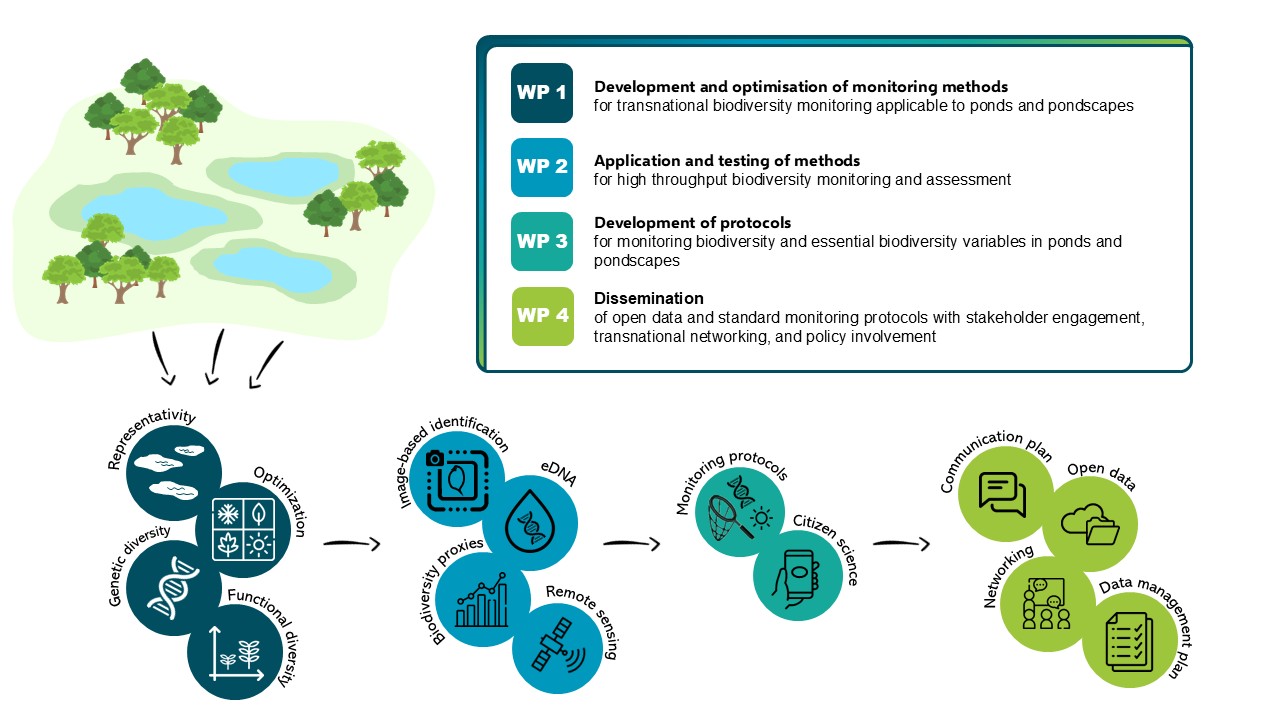
  1. are applicable to different types of ponds and different climatic zones and land-use contexts;
  2. cover different key taxonomic groups that capture different aspects of pond biota;
  3. cover both taxonomic, functional (providing a synthetic summary linked to ecosystem functioning) and genetic diversity (reflecting evolutionary potential, in both zooplankton and macrophytes);
  4. allow time- and resource effective sampling through a high degree of automation (sensors, eDNA, artificial intelligence aided identification of zooplankton and macroinvertebrates, remote sensing), enabling a broader coverage.

Main activities

TRANSPONDER will develop and assess methods allowing efficient biodiversity assessment of ponds. The project will combine existing data with new data to assess the representativeness of a few ponds of the wider pondscape in terms of how they reflect the broader biodiversity. Optimisation methods and sampling protocols to assess taxonomic, genetic and functional diversity will be developed and applied. These will include automated identification systems using artificial intelligence, eDNA, and community metabarcoding.

The project will also explore methods for upscaling biodiversity assessment proxies to the landscape level and the use of remote sensing approaches to track changes in pond hydrology and essential biodiversity variables (EBVs) at a large scale.

Finally, we will engage with different stakeholder groups to:

  • explore the interest in applying pond monitoring and incorporating ponds and pondscapes in policies and monitoring activities;
  • co-develop the monitoring protocols to facilitate uptake and implementation by different actors;
  • simplify the monitoring protocols so that they become amenable for citizen-mediated monitoring, allowing further expansion of the scope of monitoring.